TreeWriter: AI-Assisted Hierarchical Planning and Writing for Long-Form Documents
TreeWriter Is Here: Breaking Free from Linearity and Making Long-Form AI Writing More Controllable with a “Tree Structure”
Anyone who has written a long paper, project proposal, or technical document knows it can feel like a total “memory disaster.”
ArXiv URL:http://arxiv.org/abs/2601.12740v1
When you’re facing a document that spans dozens of pages, your brain’s memory often just isn’t enough: what was the terminology defined earlier? Does this argument conflict with the logic in Chapter 3? Existing AI assistants, such as ChatGPT or Notion AI, can help polish paragraphs, but they are usually “linear” — they’re good at handling local text, yet struggle to understand the larger structure of your writing.
Why can’t we write articles the way we write code: modularly and in layers?
A research team from the University of Toronto, NVIDIA, and other institutions has provided the answer. They introduced a new writing system called TreeWriter, which models documents as a “tree structure” and deeply integrates AI agents, perfectly solving the problems of structural confusion and context loss in long-form writing.
The Pain Points of Long-Form Writing: Cognitive Overload
Psychological research shows that writing is a non-linear process involving repeated cycles of planning, generation, and revision. In long-form writing, authors need to build a large amount of “Cognitive Scaffolds” — such as outlines, drafts, and fragmented ideas.
However, existing AI writing tools mainly fall into two categories:
-
Inline Editors: such as Wordcraft, which focus on polishing and continuing local text.
-
Conceptual Editors: which provide some outlining features, but are often disconnected from the main text.
These tools all overlook a key point: Hierarchy. When a document becomes complex, a linear view can leave the author lost in the details, making high-level planning difficult.
TreeWriter: The Document as a “Tree”
The core idea of this research is: a document is essentially a tree.
TreeWriter does not force users to type in one long page; instead, it provides two complementary views:
-
Tree View: This is the core creation area. Users can create nodes, each representing a chapter, paragraph, or idea. You can freely drag and rearrange these nodes into a hierarchy.
-
Linear View: This is the reader’s final perspective. The system traverses the tree structure and stitches together the content of all nodes into a complete article.
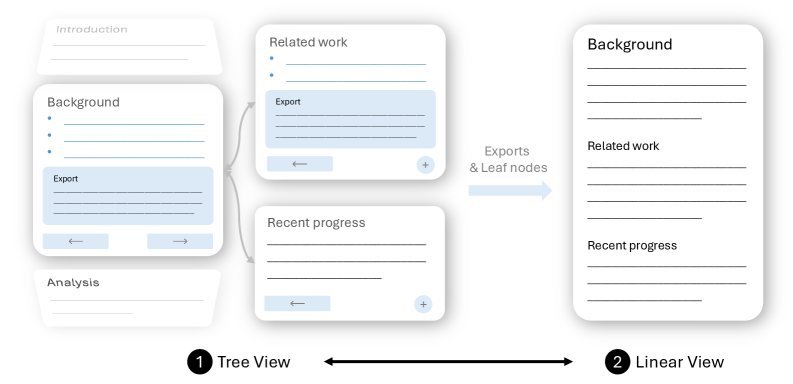
The biggest advantage of this design is that it achieves separation of concerns. In Tree View, you can focus on the logical architecture; in Linear View, you can check the flow and readability of the writing.
How Does AI Fit into the “Tree”?
The AI in TreeWriter is not just a chatbot; it is a Context-Aware intelligent agent. It understands the “node” you are currently in and its position within the entire tree.
The system has designed several highly practical AI collaboration features:
1. Automatic Split & Summarize
When you’ve written a long, messy draft, you can let the AI “split” it into multiple child nodes with one click, creating a clearer structure. Conversely, you can also have the AI read the content of all child nodes and automatically generate a high-level summary outline in the parent node.
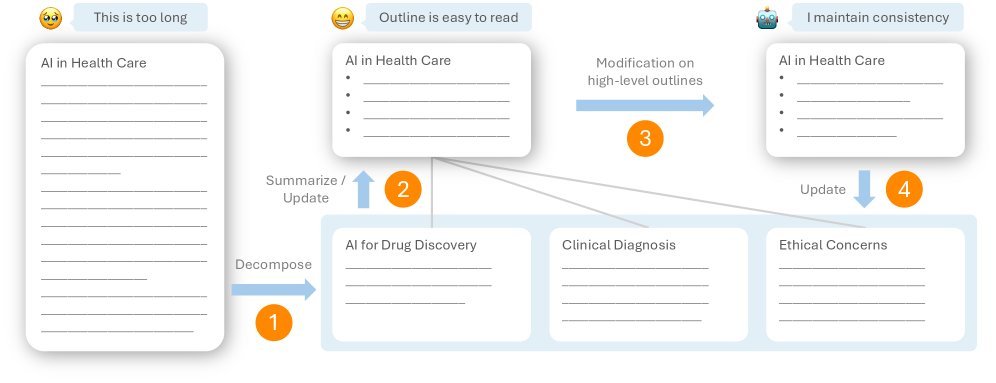
2. Bidirectional Synchronized Generation
This is one of TreeWriter’s coolest features. It allows the “outline” and the “body text” to drive each other in both directions:
-
Outline to Body Text: Write a one-sentence outline, and the AI automatically expands it into a detailed paragraph.
-
Body Text to Outline: Write the body text, and the AI automatically distills the core outline, making it easier to review later.
This mechanism ensures that “macro planning” and “micro writing” always stay aligned.
3. Intelligent Consistency Checking
In long documents, you may change the setup in Chapter 1 and then forget to update the conclusion in Chapter 5. TreeWriter’s AI agents can traverse the entire tree and make cross-node edits according to your instructions (for example, “change all mentions of ‘Model A’ to ‘Model B’ and update the related arguments”).
Experimental Results: Outperforming Traditional Document Editors
To validate the system, the research team conducted a within-subject experiment ($N=12$), comparing TreeWriter with Google Docs + Gemini (Google’s strongest AI document combination).
The tasks included revising a 4,000-word long article and writing a new 800-word piece. The results showed:
-
Better idea exploration: Users felt that the tree structure greatly promoted divergent thinking and organization.
-
Higher AI usefulness: Users found the AI here more helpful than simply chatting in Google Docs, because the AI “understands” structure.
-
Stronger sense of control: Even though the AI was involved a lot, users felt they had even more control over the article.
In addition, in a two-month field deployment study ($N=8$), participants used it for real collaborative writing and found that the hierarchical structure significantly reduced communication costs in multi-person collaboration.
Conclusion
TreeWriter shows us the future of AI-assisted writing: evolving from “help me write this sentence” to “help me plan this article.”
By structuring documents as a “tree,” it not only solves the cognitive load problem of long-form writing, but also gives AI a precise handle to operate on. For engineers and researchers who often need to write lengthy, detailed documents, this mode of “structured thinking + AI generation” may be the real productivity revolution.